Staircase lighting is no longer limited to a ceiling fixture or a row of wall-mounted step lights.
Modern lighting systems can illuminate individual steps, activate automatically when someone approaches and create progressive lighting effects that follow movement through a staircase.
For homeowners, interior designers and electrical contractors, this raises an important question: is motion sensor stair lighting actually better than traditional stair lighting?
The answer depends on the project.
Both approaches can provide effective illumination, but they differ in installation requirements, user experience, maintenance and design flexibility.
Traditional staircase lighting generally refers to fixed lighting installations controlled by conventional switches, timers or building lighting controls.
Common examples include wall-mounted step lights, recessed stair lights, ceiling downlights and linear lighting beneath handrails.
These systems may use LED technology, but their main function is usually to provide steady illumination.
A traditional staircase installation might include a series of recessed wall lights connected to a single switch.
When the switch is activated, all connected lights turn on simultaneously.
This approach is familiar to installers and can be particularly suitable for projects requiring consistent, predictable illumination.
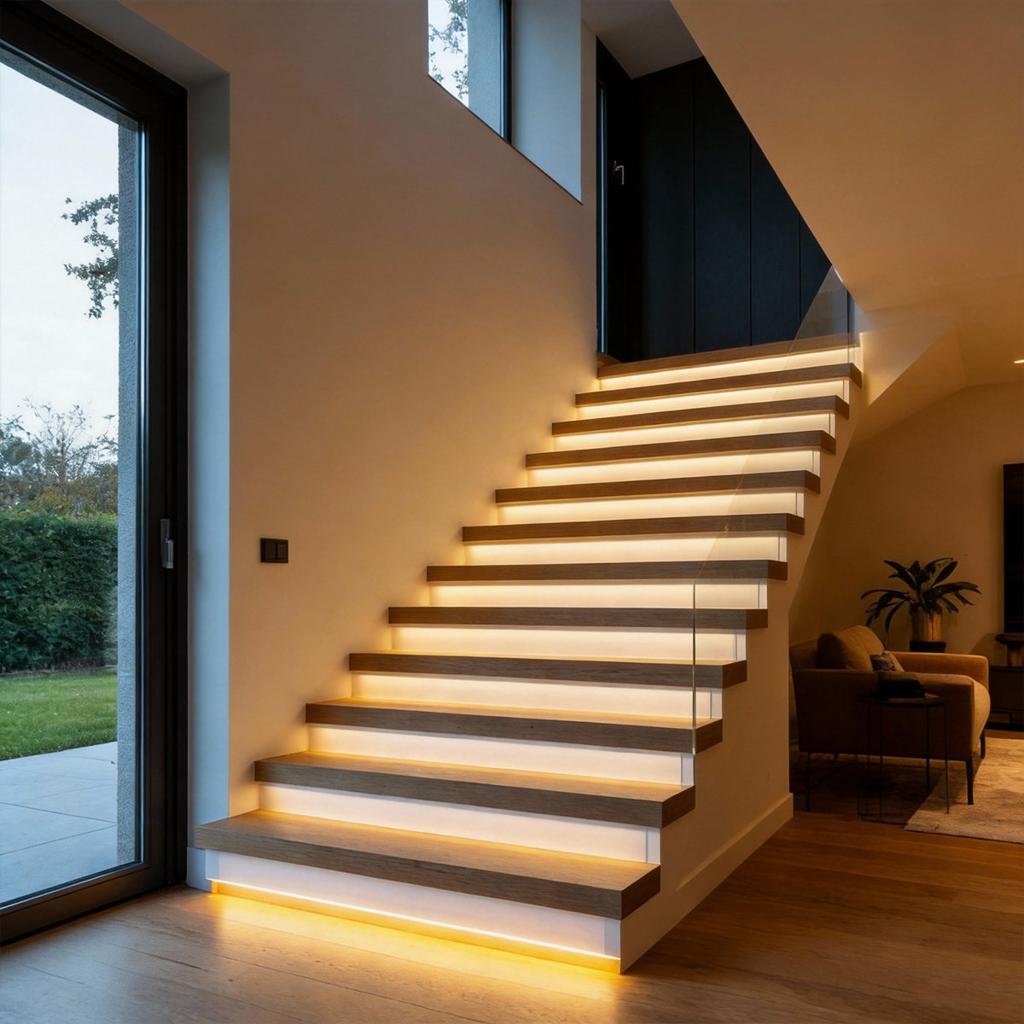
Motion sensor stair lighting uses one or more sensors to detect movement and activate the lighting automatically.
A basic system may simply turn on all connected lights when motion is detected.
More advanced systems can use programmable controllers to create sequential or progressive effects.
For example, a compatible addressable LED strip and controller can create a water flow effect along a staircase.
Dual-sensor systems can detect movement from both ends of the stairway.
Depending on the controller, users may also be able to adjust brightness, lighting speed and switch-off timing.
The main advantage is convenience: occupants do not need to locate a wall switch before entering the staircase.
3. Comparison at a Glance
| Feature |
Motion Sensor Lighting |
Traditional Lighting |
| Activation |
Automatic when motion is detected |
Usually manual or centrally controlled |
| Lighting Effect |
Static or dynamic, depending on controller |
Usually static |
| Convenience |
Hands-free operation |
Depends on switch placement |
| Installation |
Requires sensors and compatible controls |
Often simpler |
| Energy Use |
Depends on activation frequency and settings |
Depends on operating schedule |
| Maintenance |
Includes sensors and electronics |
Usually fewer control components |
| Design Flexibility |
High with compatible LED systems |
High with appropriate fixtures |
| Initial Cost |
Often higher for advanced systems |
Varies by fixture and installation |
| Safety Performance |
Depends on detection and lighting design |
Depends on lighting design |
Neither system is automatically safer or more energy-efficient. Performance depends on the complete installation.
4. Convenience and Everyday Use
One of the clearest advantages of motion sensor staircase lighting is hands-free operation.
This can be useful when carrying luggage, moving household items or walking through a staircase at night.
Instead of searching for a switch, the lighting activates when the sensor detects movement.
Traditional lighting can provide a similar level of convenience when paired with well-positioned two-way switches or occupancy sensors.
However, a properly configured dual-sensor system can reduce the need for manual interaction.
The quality of the experience depends heavily on sensor placement and detection reliability.
5. Energy Efficiency: Which System Uses Less Electricity?
Motion sensor lighting is often marketed as an energy-saving solution, but the actual savings depend on usage.
Consider two staircase installations using the same 100W lighting load.
If traditional lighting remains on for five hours each day, its daily consumption is:
100W × 5h = 500Wh
If an automatic system operates for a total of one hour each day, its active lighting consumption is:
100W × 1h = 100Wh
In this example, automatic operation reduces the active lighting energy consumption by 80%.
However, this comparison excludes standby power consumption and assumes that the automatic lighting operates for only one hour.
A traditional system connected to a timer or occupancy sensor may achieve similar savings.
For commercial projects, energy calculations should be based on actual operating hours, control behavior and standby loads.
6. Architectural Design and Visual Appearance
Traditional recessed step lights remain popular because they can provide discreet, focused illumination.
They are often installed in walls beside the staircase or directly into stair risers.
Their appearance depends on fixture dimensions, beam distribution and installation height.
Motion sensor LED strip systems offer a different visual approach.
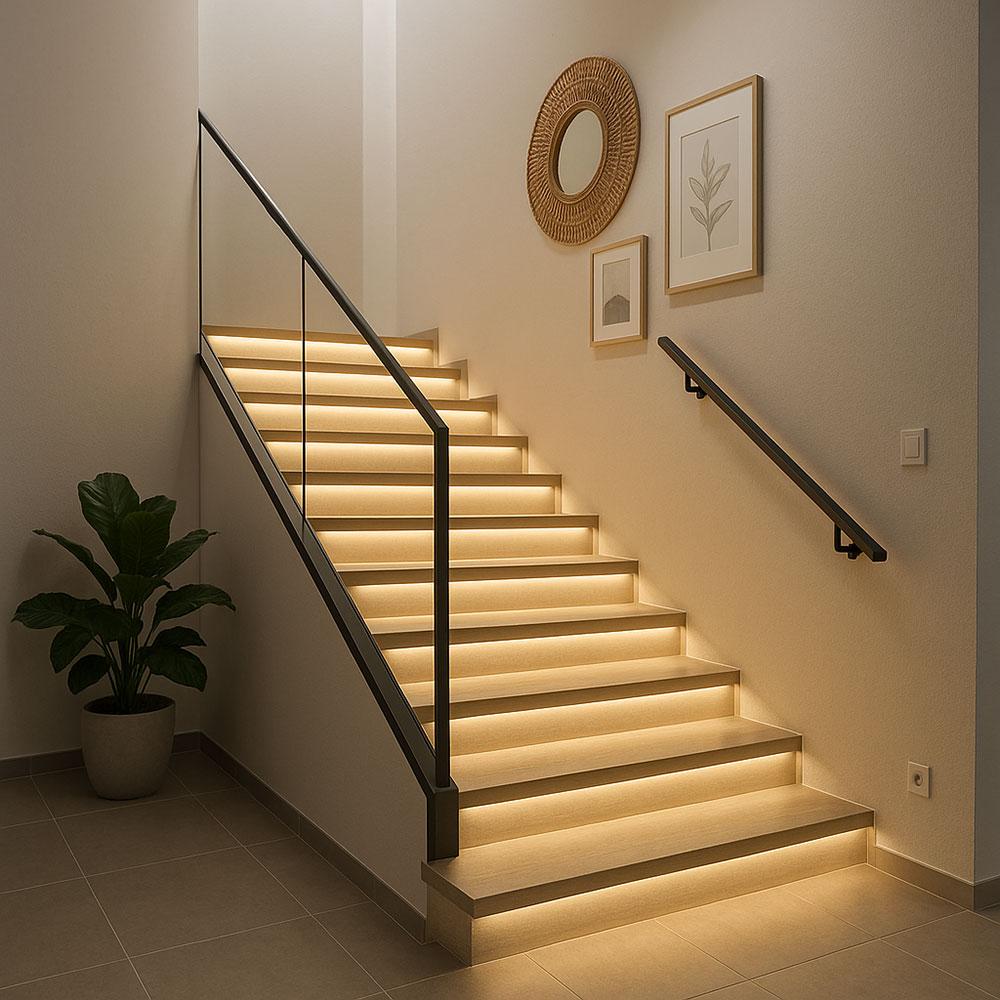
A COB LED strip can create a continuous line of light beneath the tread or along a staircase profile.
When paired with a compatible controller, the lighting can also produce animated effects.
This can be particularly attractive in modern villas, duplex apartments and contemporary hospitality interiors.
However, decorative animation should not distract users or compromise safe movement.
7. Installation Complexity
Traditional stair lighting can be straightforward when the electrical layout has already been planned.
For example, a series of recessed LED wall lights may be connected to a compatible driver and switch circuit.
Motion sensor systems require additional consideration.
Installers must account for sensor placement, controller compatibility, wiring, power distribution and operating logic.
Addressable LED strips introduce further requirements, including signal direction and pixel configuration.
A complete lighting kit can simplify product selection, but installation quality still depends on correct wiring and system configuration.
8. Maintenance and Long-Term Reliability
Both systems require appropriate thermal management and accessible electrical connections.
Traditional fixtures may be easier to replace individually, depending on their construction.
A continuous LED strip can be more difficult to service if it is concealed inside a permanently finished staircase.
Motion sensor systems also contain electronic components that may eventually require replacement.
For long-term projects, designers should provide access to the controller, power supply and critical wiring connections.
It is also useful to confirm whether replacement sensors and controllers will remain available.
9. Safety Considerations
Staircase lighting should help users identify tread edges, changes in level and potential obstacles.
Motion-activated systems can improve convenience by providing illumination before someone enters a dark staircase.
However, the sensors must activate reliably, and the lighting should remain on long enough for users to complete their movement.
For some installations, permanent background lighting may still be necessary.
Emergency lighting and code-required illumination must be designed separately where applicable.
Neither motion sensor lighting nor traditional lighting should be selected solely for its decorative appearance.
10. Which Is Better for Residential Projects?
For many modern homes, motion sensor lighting offers an appealing combination of convenience and visual design.
It is particularly suitable for staircases that are used intermittently and where hands-free operation is valuable.
Traditional lighting remains a strong choice for homeowners who prefer simple controls, fixed illumination and fewer electronic components.
A hybrid approach can also work well.
For example, a staircase may use conventional downlights for general illumination and motion-activated LED strips for supplementary accent lighting.
This arrangement can provide both functional lighting and architectural atmosphere.
11. Which Is Better for Hotels and Commercial Buildings?
Commercial projects require additional consideration.
Building regulations, maintenance requirements, occupancy patterns and emergency lighting provisions may influence the final design.
Traditional fixed lighting can be appropriate where continuous illumination is required.
Motion sensor systems may be useful for supplementary architectural lighting in selected interior areas.
However, decorative sensor-controlled lighting should not be treated as a substitute for required safety lighting.
For commercial projects, lighting designers should review the relevant local standards before selecting the system.
12. Cost Comparison
The total installed cost of a staircase lighting system includes more than the price of the light fixtures.
It may include:
-
LED strips or individual luminaires
-
Controllers and power supplies
-
Motion sensors
-
Aluminum profiles and diffusers
-
Wiring and installation labor
-
Testing and commissioning
-
Future maintenance
An advanced motion sensor system may have a higher initial component cost than a simple switched installation.
However, installation costs vary significantly with the staircase construction and available wiring routes.
A detailed project comparison should use the same staircase dimensions and lighting performance requirements.
For projects requiring automatic operation and dynamic effects, a complete 24V kit may be a practical starting point.
USKYLED offers a motion sensor staircase lighting system with 5m, 10m and 15m options.
The system combines a compatible SPI COB LED strip, dual motion sensors and an integrated lighting controller.
Available configurations include 3000K, 4000K and 6000K white light options.
Before ordering, buyers should confirm the staircase dimensions, controller input voltage and installation requirements.
Conclusion: Which Stair Lighting System Should You Choose?
Traditional stair lighting remains a reliable solution for projects requiring simple controls and consistent illumination.
Motion sensor stair lighting is particularly attractive when automatic operation, hands-free convenience and architectural lighting effects are important.
For many modern residential projects, the best solution is not necessarily one system or the other.
Combining functional staircase illumination with carefully designed automatic accent lighting can provide a balanced result.
Explore USKYLED Motion Sensor Stair Lighting:
https://www.uskyled.com/products/24v-motion-sensor-stair-led-strip-light-kit
USKYLED supports lighting distributors, installers and project buyers with staircase lighting solutions and customization discussions.


