How to Choose a 24V COB LED Strip Kit for Staircase Lighting
Choosing an LED strip for a staircase may seem straightforward, but the final performance depends on several technical details.
Operating voltage, LED density, power consumption, control technology and installation method all influence the lighting result.
For lighting contractors, distributors and interior designers, these factors are especially important when selecting a system for a complete residential or commercial project.
A well-matched 24V COB LED strip kit can provide a continuous lighting appearance, convenient control and flexible installation options.
This guide explains what to look for before purchasing.
1. Why Choose COB LED Strips for Staircase Lighting?
COB stands for Chip on Board.
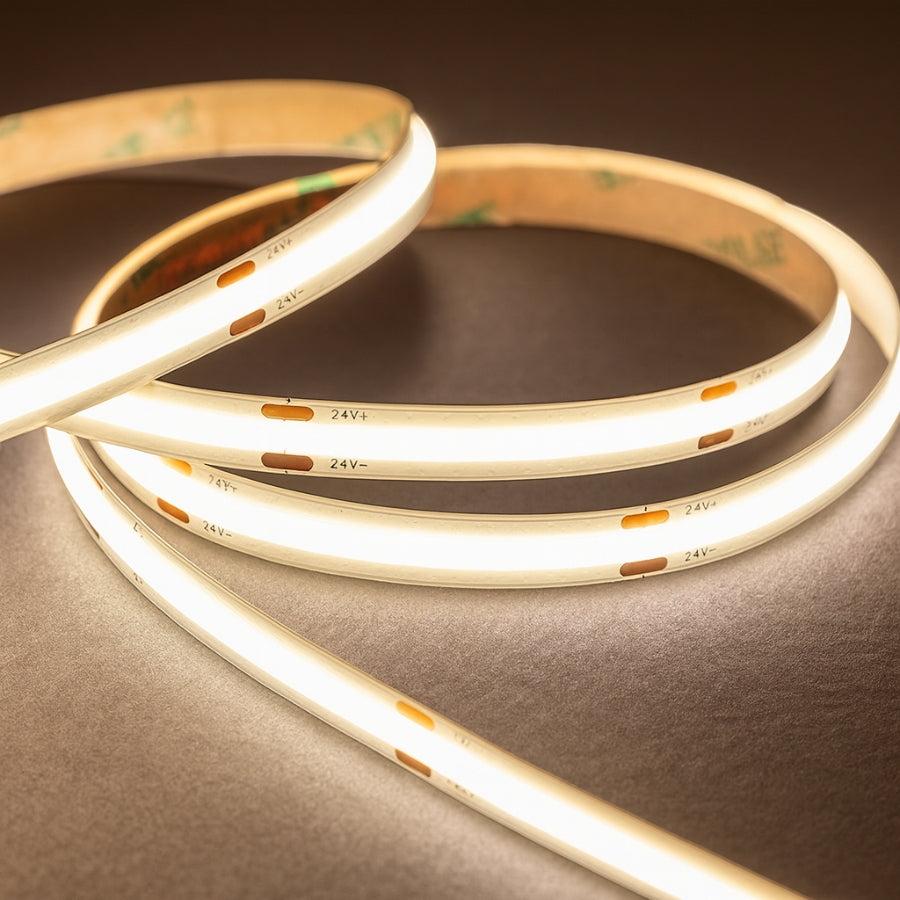
In a COB LED strip, multiple LED chips are arranged closely together beneath a continuous encapsulation layer.
This construction creates a more uniform light-emitting surface than many conventional low-density SMD LED strips.
For staircase lighting, the visual advantage can be significant.
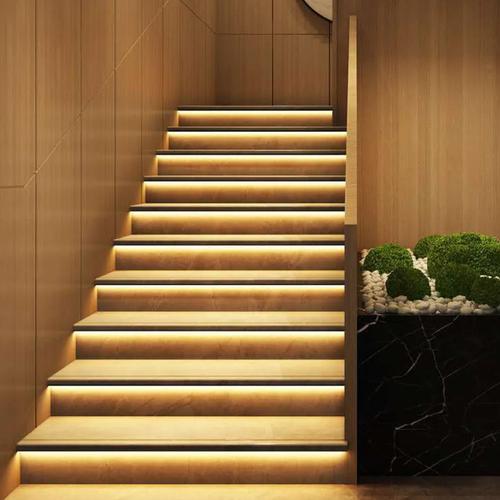
When an LED strip is installed beneath a stair tread or inside a shallow aluminum profile, individual LED points may become visible.
A high-density COB strip helps reduce this dotted appearance.
However, the final uniformity also depends on the diffuser, profile depth and viewing angle.
2. Why 24V Is a Practical Choice
Low-voltage LED strips are commonly available in 12V and 24V versions.
For many staircase lighting projects, 24V provides a useful balance between component availability and electrical performance.
At the same power level, a 24V strip draws half the current of a 12V strip.
For example, a 120W lighting load requires approximately:
120W ÷ 12V = 10A
At 24V:
120W ÷ 24V = 5A
Lower current can reduce resistive losses in the wiring when conductor dimensions and routing are otherwise comparable.
Nevertheless, long strip runs still require careful voltage-drop calculations.
The power supply and controller must also be compatible with the selected operating voltage.
3. Check the LED Density
LED density is usually expressed as LEDs per meter.
For COB products, this figure indicates how many LED chips are distributed along the strip.
A high-density product may use 360 or more chips per meter.
However, a higher LED count does not automatically mean higher brightness or better efficiency.
Actual performance depends on chip characteristics, operating current, optical design and thermal management.
For architectural staircase lighting, buyers should evaluate the visible light uniformity as well as the nominal LED density.
Requesting a working sample is often the most reliable way to assess the appearance.
4. Choose Between Static and Addressable COB LED Strips
One of the most important decisions is whether the staircase requires static lighting or animated effects.
A conventional single-color COB strip normally illuminates as one continuous circuit.
It can be switched or dimmed using a compatible controller.
This type is suitable for projects requiring steady illumination beneath steps or along architectural details.
Addressable SPI COB LED Strip
An addressable strip contains controllable pixels or segments.
When paired with a compatible controller, it can create progressive lighting effects.
For example, the strip may illuminate sequentially to produce a water flow appearance.
Addressable strips require the correct control protocol, signal wiring and pixel configuration.
Buyers should not assume that every COB LED strip supports animation.
5. Calculate the Required LED Strip Length
The correct strip length depends on the staircase layout.
For under-step lighting, measure the illuminated width of each step and multiply it by the number of steps.
For example:
14 steps × 0.9m = 12.6m
This is the nominal illuminated length.
Additional cable allowances and installation details should be considered separately.
For a continuous lighting installation along the side of a staircase, measure the actual route rather than relying only on the staircase's horizontal dimensions.
A kit offered in 5m, 10m or 15m lengths may suit different layouts, but buyers should confirm the permissible cutting points and maximum supported configuration.
6. Calculate the Power Consumption
Power consumption is usually specified in watts per meter.
Consider a 24V COB LED strip rated at 11.52W/m.
The nominal power requirements are:
| Strip Length |
Nominal Power |
| 5m |
57.6W |
| 10m |
115.2W |
| 15m |
172.8W |
These calculations are useful for preliminary system planning.
However, the final power supply selection should also consider controller losses, wiring, operating conditions and the manufacturer's design recommendations.
A suitable power margin may be necessary depending on the system.
For longer installations, additional power injection may be required to maintain consistent brightness.
7. Select the Correct Stair Lighting Controller
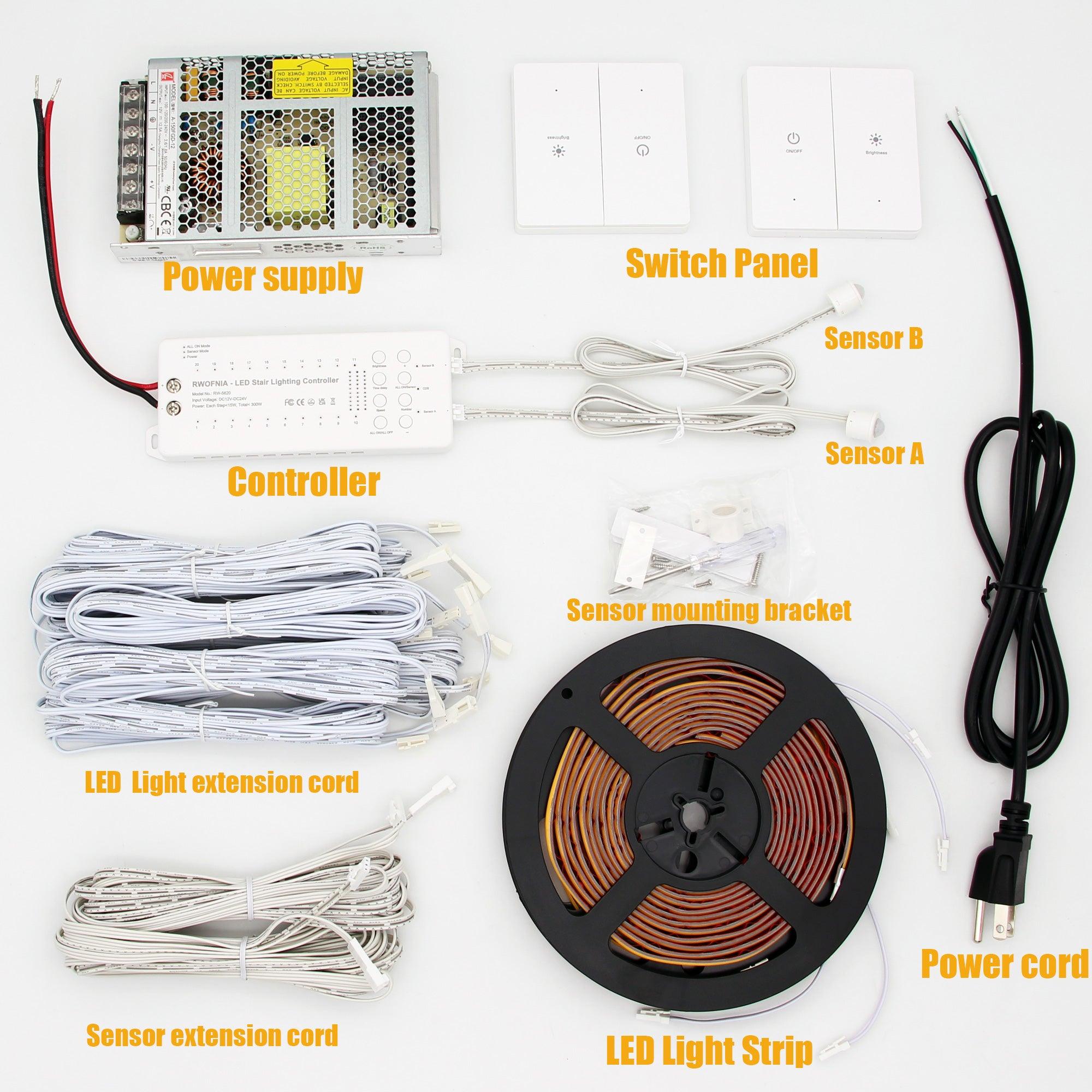
A controller determines how the lighting system operates.
For a basic installation, a simple dimmer or switch may be sufficient.
For motion-activated progressive lighting, the controller must support both the sensor inputs and the selected addressable LED strip.
Important controller functions may include:
Motion Sensor Input
Allows the system to activate when movement is detected.
Brightness Adjustment
Provides control over the light output.
Animation Speed
Adjusts how quickly the lighting effect travels along the strip.
Pixel Configuration
Matches the controller's output to the addressable segments of the strip.
Automatic Switch-Off Delay
Determines how long the lighting remains active after the relevant trigger.
Direction Control
Allows the animation direction to be configured where supported.
For projects requiring activation from both ends of a staircase, a dual-sensor controller is often preferable.
8. Understand the Controller Input Voltage
This specification is particularly important for international buyers.
The LED strip may operate at DC 24V, but the integrated power supply can have a separate AC mains input rating.
For example, a controller specified for AC 175–265V is intended for compatible mains supplies within that range.
It cannot be connected directly to a 110V supply.
For projects in North America, buyers should confirm whether a compatible 120V-input power supply and controller configuration is available.
Never assume that a product advertised as 24V is automatically suitable for every country's mains supply.
9. Choose the Right Color Temperature
Color temperature affects the atmosphere of a staircase.
3000K Warm White
Warm white is a popular choice for residential interiors, hotels and spaces with natural wood finishes.
It creates a comfortable visual appearance and works well with warm-toned materials.
4000K Natural White
Natural white provides a more neutral appearance.
It can be suitable for contemporary interiors, corridors and functional architectural lighting.
6000K Cool White
Cool white produces a crisp appearance that may suit selected modern interior designs.
However, cooler light is not automatically brighter or more suitable for every staircase.
The final choice should consider surrounding materials, lighting levels and the overall interior design.
10. Check the Aluminum Profile Compatibility
The aluminum profile affects both the appearance and durability of the installation.
Before purchasing, check the LED strip width and the internal dimensions of the profile.
A 10mm-wide strip requires sufficient clearance for the PCB and connections.
For permanent staircase installations, consider profiles with appropriate mechanical protection and thermal performance.
A suitable diffuser can help create a softer light line.
The mounting method should also allow reasonable access for future maintenance.
11. Consider Motion Sensor Performance
Motion sensors are not interchangeable.
Different products may use PIR, microwave or other sensing technologies.
Each technology has different installation and detection characteristics.
When comparing staircase lighting kits, check:
A dual-sensor system is useful when occupants approach the staircase from both directions.
However, the detection zones must be tested during installation.
12. Evaluate Reliability and Maintenance
For professional lighting projects, reliability should be considered from the beginning.
Important factors include thermal management, power supply quality, connector reliability and controller accessibility.
A lighting system installed inside a finished staircase can be difficult to repair if the wiring or components are inaccessible.
For this reason, project buyers should ask about replacement components and warranty terms.
Published LED lifespan figures should also be supported by appropriate product documentation.
A claimed LED lifespan does not necessarily mean that the controller, sensors and power supply have the same expected service life.
13. Questions B2B Buyers Should Ask Suppliers
For distributors, contractors and OEM buyers, product selection involves more than choosing the correct strip length.
Before placing an order, request confirmation of:
Electrical Specifications
Operating voltage, input voltage, power consumption and controller capacity.
Control Compatibility
SPI protocol, pixel settings, sensor connections and supported lighting effects.
Product Dimensions
LED strip width, controller dimensions and installation accessories.
Testing and Certification
Applicable safety and EMC documentation for the exact model and destination market.
Customization
Available strip lengths, color temperatures, controller options and packaging requirements.
Order Conditions
MOQ, sample availability, production lead time and warranty terms.
These details help reduce installation problems and avoid purchasing incompatible components.
14. USKYLED 24V Motion Sensor Stair Lighting Kit
USKYLED offers a 24V motion sensor staircase lighting kit designed for indoor residential and architectural applications.
The product combines a high-density SPI COB LED strip, dual motion sensors and an integrated controller.
Key options include:
-
5m, 10m and 15m strip lengths
-
DC 24V LED strip operation
-
360 LED chips per meter
-
11.52W/m nominal strip power
-
10mm PCB width
-
3000K, 4000K and 6000K options
-
Adjustable brightness and animation speed
-
Automatic switch-off delay settings
The standard integrated controller is specified for AC 175–265V input.
Buyers requiring alternative mains compatibility should confirm the available configuration before ordering.
Ordering Information
Minimum Order Quantity: 1 pc
Sample Order Lead Time: 3–7 days
Mass Order Lead Time: 7–15 days
Actual lead times depend on product configuration, material availability and order quantity.
USKYLED also supports discussions about OEM/ODM requirements for lighting distributors and project buyers.
Conclusion
Choosing a 24V COB LED strip kit for staircase lighting requires a balance between visual appearance, electrical performance and installation practicality.
LED density and color temperature influence the lighting effect, while the controller and sensor configuration determine how the system operates.
For professional projects, voltage compatibility, power calculations, service access and supplier documentation are equally important.
A complete kit can simplify component selection, but technical compatibility should always be verified before installation.
Explore the USKYLED 24V Motion Sensor Stair LED Strip Light Kit:
https://www.uskyled.com/products/5m-10m-15m-sensor-motion-stairs-led-strip-light-kit-24v-cob-water-flow-staircase-step-lighting-for-interior-ladder-corridor-lamp
For project pricing, samples or customized staircase lighting solutions, contact USKYLED through www.uskyled.com.


