In architectural lighting, the quality of a linear light source is often judged by what the viewer does not see.
Individual LED points, uneven brightness and unwanted reflections can distract from an otherwise carefully designed interior.
This is particularly noticeable in shallow ceiling coves, furniture details, display shelving and decorative aluminum profiles.
High-density COB LED strips are designed to address many of these visual challenges.
A strip containing 840 LEDs per meter offers a densely arranged light source that can produce a smooth, continuous appearance when combined with an appropriate COB construction.
For architects and lighting contractors, this opens up possibilities for cleaner lines of light and more discreet integration into interior spaces.
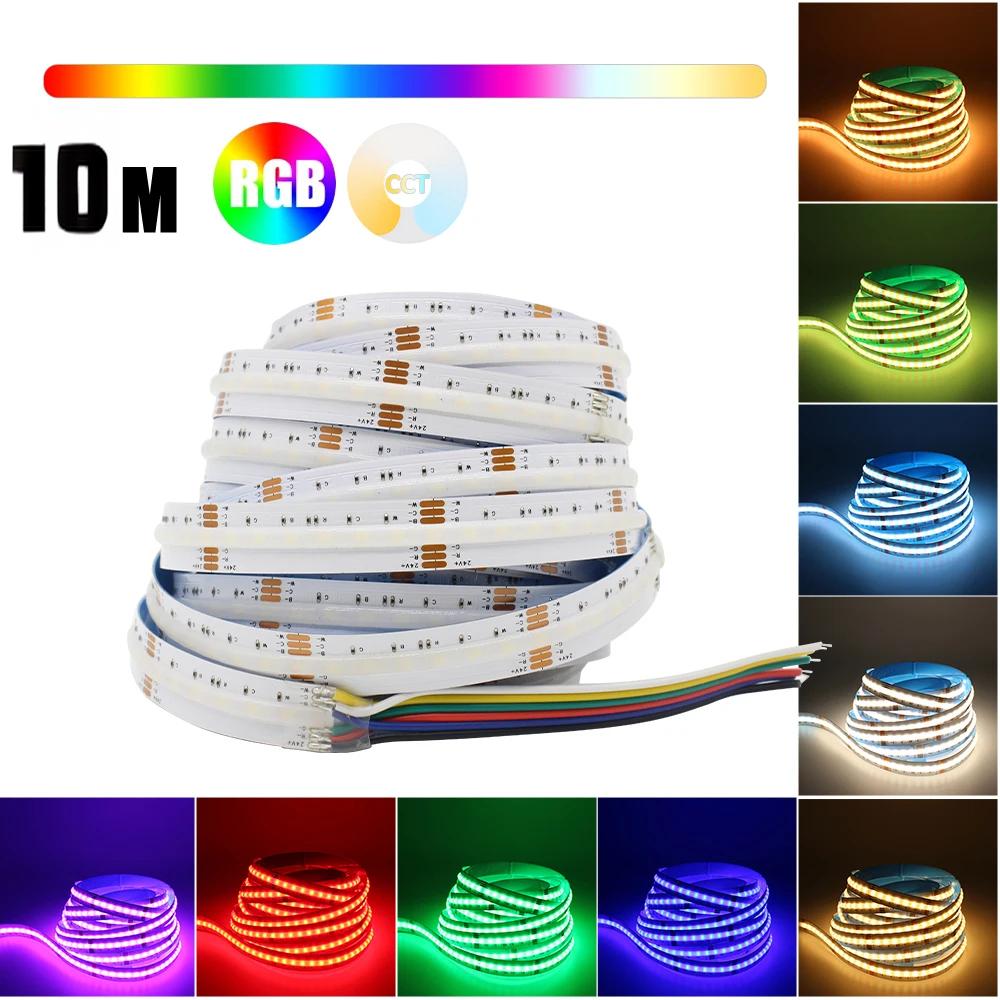
What Does 840 LEDs/m Mean?
The specification 840 LEDs/m refers to the nominal number of LED chips or light-emitting elements arranged along one meter of strip.
It does not mean that the strip contains 840 individually addressable pixels.
Nor does it establish the strip's brightness, power consumption or color rendering by itself.
Two products with the same LED density may perform differently because of differences in chip design, electrical drive conditions, phosphor materials and thermal construction.
For buyers, LED density should therefore be treated as one specification among several.
It is useful for understanding the physical arrangement of the light source, but it cannot replace a complete photometric datasheet.
Understanding COB LED Strip Technology
COB stands for chip-on-board.
In a typical COB LED strip, numerous LED chips are mounted closely together on a flexible circuit board and covered by a continuous light-emitting layer.
This differs from conventional LED strips that use individually packaged surface-mounted LEDs.
The close arrangement of the chips helps reduce the visible separation between light sources.
As a result, COB strips can produce a more continuous line of light, especially in applications where the strip is installed near the viewing surface.
The exact uniformity still depends on the strip construction, diffuser, mounting profile and viewing distance.
A high-density COB strip should not be described as completely dotless under every possible installation condition.
Why Continuous Lighting Matters in Architecture
Linear lighting is frequently used to define architectural geometry.
A ceiling cove may follow the perimeter of a room. A shelf light may emphasize a horizontal line. A recessed furniture detail may create a narrow illuminated edge.
In each case, the intended effect is usually a continuous visual element.
Visible LED dots can interrupt that appearance.
COB technology helps designers create a more uniform line, reducing the need for deep profiles solely to conceal individual LED points.
This can be especially valuable in contemporary interiors where architectural details are narrow and installation space is limited.
Applications in Ceiling Cove Lighting
Ceiling coves are among the most common uses of linear LED lighting.
The strip is generally concealed within an architectural recess, allowing light to reflect from the ceiling or nearby wall.
A high-density COB strip can help produce a smooth illuminated boundary.
However, the final result depends heavily on the geometry of the cove.
The distance between the LED strip and the illuminated surface, the mounting angle and the reflectance of the ceiling all affect the appearance.
Even an excellent COB strip may produce uneven illumination if it is positioned poorly.
For large commercial installations, lighting mock-ups are useful for confirming the intended effect before construction is completed.
Cabinet and Furniture Lighting
Cabinet lighting introduces a different set of challenges.
Installation space is often limited, and the light source may be visible from close range.
Reflective materials such as glass, polished stone and metal can make individual LED points more noticeable.
A high-density COB strip can be a practical option for display cabinets, shelving and furniture details where a smooth illuminated line is desired.
The strip must still be selected according to the intended task.
For example, a decorative RGB+CCT strip may provide flexible color effects, but a dedicated high-CRI white strip may be more appropriate for critical product display lighting.
The correct choice depends on the required light quality and visual presentation.
The Role of Aluminum LED Profiles
Aluminum profiles are widely used in professional LED strip installations.
They can provide mechanical protection, a consistent mounting surface and a finished architectural appearance.
They can also help conduct heat away from the LED strip when properly designed and installed.
The profile's dimensions must match the strip's PCB width.
A narrow channel may not accommodate a wider RGBCCT strip, particularly when connectors or cable joints are involved.
Diffusers should also be selected carefully.
A heavily diffusing cover can improve visual uniformity but may reduce delivered light output.
For this reason, profile selection should consider both appearance and optical efficiency.
Heat Management and LED Lifespan
Heat is an important factor in LED performance.
Although LEDs are efficient compared with many traditional light sources, a significant portion of their electrical input is still converted into heat.
If that heat is not managed properly, the operating temperature of the LEDs and surrounding materials may rise.
Elevated temperatures can affect luminous output, color stability and long-term reliability.
High-density LED strips deserve particular attention because many light-emitting elements are arranged within a compact area.
However, LED density alone does not determine heat generation. Actual electrical power and efficiency are more important.
For professional installations, the manufacturer's thermal recommendations should be followed.
An appropriate aluminum profile, adequate ventilation and correct power loading can all contribute to reliable operation.
Why 24V Is Common in Architectural LED Strips
Many architectural LED strips operate at DC24V.
Compared with a 12V strip delivering the same power, a 24V system draws approximately half the current.
This can reduce voltage drop and resistive cable losses for a given conductor size and cable length.
Nevertheless, long runs still require electrical planning.
The installer should calculate the connected load, confirm allowable strip length and consider additional power injection where required.
A 24V rating does not mean that any number of strips can be connected end to end.
Combining COB with RGBCCT Lighting
The benefits of COB construction become particularly interesting when combined with RGBCCT control.
RGBCCT strips provide RGB color channels together with separate warm white and cool white channels.
This allows a single lighting installation to support decorative color effects and adjustable white-light appearances.
In a hospitality environment, for example, the lighting may use warm white during normal operation and decorative colors for special events.
In a residential interior, the same system may be adjusted for different activities.
The control system must be compatible with the strip's channel arrangement and electrical requirements.
What to Check Before Ordering
Professional buyers should request more than an LED density figure.
Important specifications include power consumption per meter, PCB width, cutting interval, color temperature range, CRI, operating voltage and IP rating.
For RGBCCT strips, controller compatibility and the maximum current of each channel are also essential.
The supplier should be able to explain how the strip is intended to be powered and installed.
For large projects, sample testing can help confirm the actual lighting appearance and compatibility with the proposed aluminum profile.
USKYLED 840 LEDs/m RGBCCT COB LED Strip
USKYLED offers a DC24V RGBCCT COB LED strip with a nominal density of 840 LEDs per meter and a 5-meter length.
The product combines a high-density COB construction with RGB and tunable white lighting capabilities.
Potential applications include architectural coves, interior accent lighting, suitable cabinet installations and decorative commercial lighting.
Project buyers should confirm the exact PCB width, wattage, CCT range and controller requirements before final specification.
View USKYLED 840 LEDs/m RGBCCT COB LED Strip
Conclusion
An 840 LEDs/m COB LED strip can be an effective choice for architectural lighting where visual continuity is important.
Its high-density construction can help create smooth illuminated lines in ceiling coves, furniture profiles and decorative interior details.
However, LED density should never be evaluated in isolation.
Power consumption, thermal management, optical performance, color quality and installation conditions all contribute to the finished result.
For architects, contractors and lighting distributors, the best specification is the one that balances visual quality with long-term reliability.


