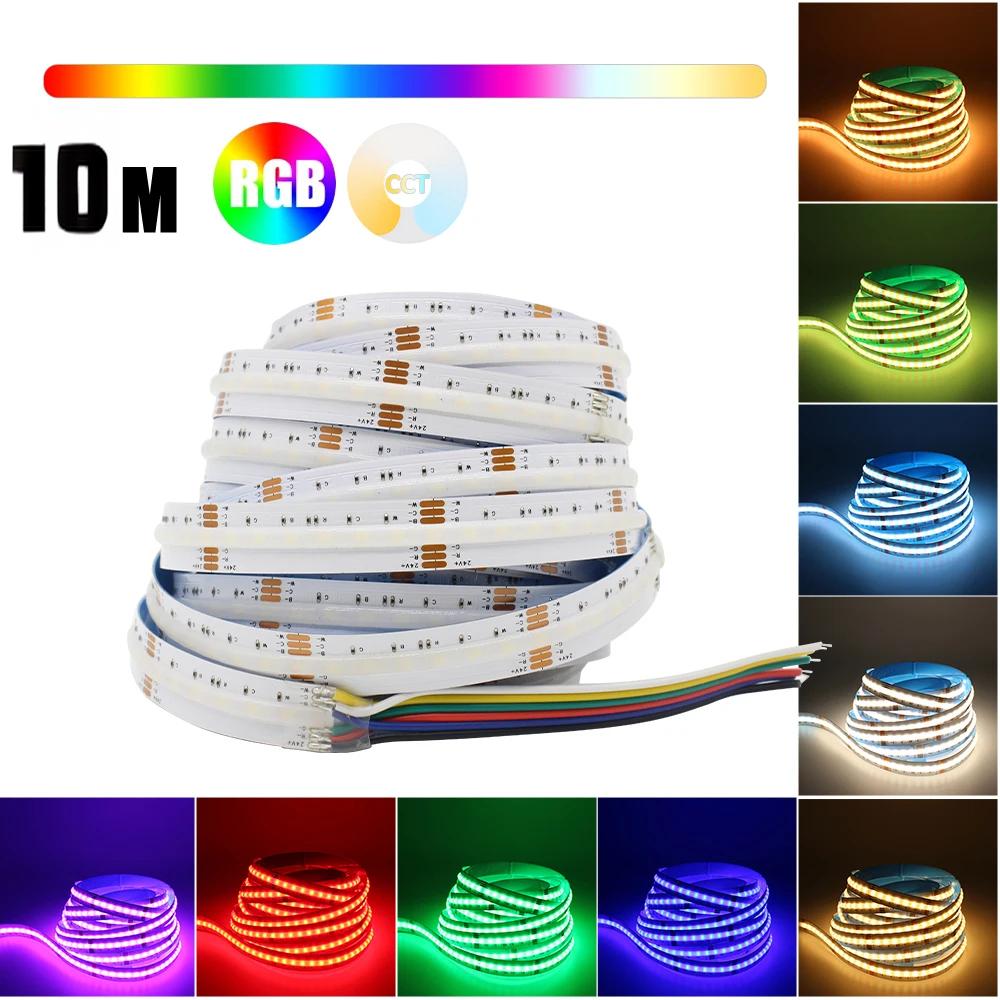
Choosing an LED strip used to be relatively straightforward. For simple accent lighting, a single-color strip was often sufficient. If a project needed decorative colors, RGB was the natural choice.
Today, lighting designers have more options. RGB, RGBW and RGBCCT LED strips may look similar when switched off, but their internal channel arrangements and lighting capabilities are different.
Understanding those differences matters when selecting lighting for homes, hotels, retail displays and architectural projects.
What Is an RGB LED Strip?
RGB stands for red, green and blue. By varying the intensity of these three color channels, an RGB LED strip can produce a wide range of colors.
RGB strips are widely used in gaming rooms, entertainment spaces, decorative ceiling coves and other applications where colored lighting is the main objective.
Although an RGB strip can produce an approximate white appearance by combining red, green and blue, that mixed white is not equivalent to light produced by a dedicated white LED channel.
Its color rendering, consistency and visual appearance depend on the LED package and control system.
What Is an RGBW LED Strip?
RGBW adds a dedicated white channel to the red, green and blue channels.
The extra channel allows the strip to produce white light without relying entirely on a mixture of RGB colors.
This can improve the practicality of a strip used for both decorative colored lighting and everyday white illumination.
However, an RGBW strip generally provides one dedicated white channel with a fixed nominal color temperature.
For example, a particular model may include warm white or neutral white LEDs. That does not mean the strip can independently tune between warm and cool white.
What Is an RGBCCT LED Strip?
RGBCCT combines RGB color channels with two dedicated white channels, normally warm white and cool white.
The term CCT refers to correlated color temperature.
With an appropriate controller, the two white channels can be blended to create intermediate white appearances between the strip's specified warm and cool endpoints.
This makes RGBCCT particularly useful where a lighting system needs both decorative RGB effects and adjustable white light.
A residential living room, for example, may use warmer white light in the evening and a cooler white appearance for certain daytime activities.
The same strip can also provide decorative colored lighting for entertainment.
RGB vs RGBW vs RGBCCT: Technical Comparison
RGB typically uses three controllable channels: red, green and blue.
RGBW typically uses four: red, green, blue and one white channel.
RGBCCT typically uses five: red, green, blue, warm white and cool white.
These channel counts describe conventional analog multi-channel strips. Individually addressable products may use different electrical architectures.
The key difference is not simply the number of colors advertised. It is how the strip produces white light and how much control the designer has over its appearance.
Which Technology Produces Better White Light?
Dedicated white channels are generally preferable when white illumination is an important requirement.
An RGB-only strip produces white through color mixing, which may not provide the same quality or consistency as a purpose-designed white LED.
RGBW provides a dedicated white channel, but usually with one nominal color temperature.
RGBCCT provides two white channels that can be mixed for adjustable white illumination.
Nevertheless, RGBCCT does not automatically guarantee high color rendering or accurate color temperature.
Those characteristics must be confirmed through the LED specifications and photometric testing.
For retail displays, museums and premium interiors, CRI, color consistency and actual spectral performance remain important selection criteria.
Why COB Technology Matters
COB, or chip-on-board, describes a construction method in which many LED chips are arranged densely and covered by a continuous light-emitting layer.
Compared with many traditional exposed-chip LED strips, COB construction can produce a smoother visual line with less visible separation between individual light sources.
This is useful in shallow aluminum profiles, illuminated shelving and architectural details where the strip may be viewed directly.
COB and RGBCCT describe different characteristics.
COB refers to the physical LED construction, while RGBCCT describes the color-channel arrangement.
A strip can therefore combine both technologies.
Controller Compatibility
One of the most common mistakes in LED strip projects is selecting a controller based only on the word RGB.
A conventional RGB controller generally cannot independently operate the two white channels of an RGBCCT strip.
For a typical analog RGBCCT system, a compatible five-channel controller is required.
The power supply must also match the strip's rated voltage and total electrical load.
Buyers should confirm whether the strip uses a common-positive connection arrangement and verify the actual terminal labels.
Which LED Strip Is Best for Your Project?
Choose RGB when decorative colors are the main requirement and dedicated white light is not essential.
Choose RGBW when a project needs RGB effects together with one dedicated white channel.
Choose RGBCCT when both RGB color effects and adjustable white lighting are important.
For residential interiors, hospitality projects and furniture lighting, RGBCCT can offer useful design flexibility.
However, a separate high-performance white lighting system may still be preferable where strict illumination quality or color rendering requirements apply.
USKYLED 24V RGBCCT COB LED Strip
USKYLED offers a 24V RGBCCT COB LED strip with a nominal density of 840 LEDs per meter and a 5-meter length.
The combination of RGB+CCT control and high-density COB construction makes it relevant to interior decorative lighting, architectural coves and suitable cabinet lighting applications.
The exact power consumption, color temperature range, PCB width, CRI and compatible controller specifications should be confirmed before project installation.
Conclusion
RGB, RGBW and RGBCCT LED strips are designed for different lighting priorities.
RGB is primarily focused on decorative colors. RGBW adds a dedicated white channel. RGBCCT provides separate warm and cool white channels for tunable white lighting alongside RGB effects.
For designers and contractors, the best choice depends on the required white-light performance, control system, installation conditions and project budget.
Explore USKYLED RGBCCT COB LED strips at https://www.uskyled.com/products/24v-rgbcct-cob-led-strip-840leds.