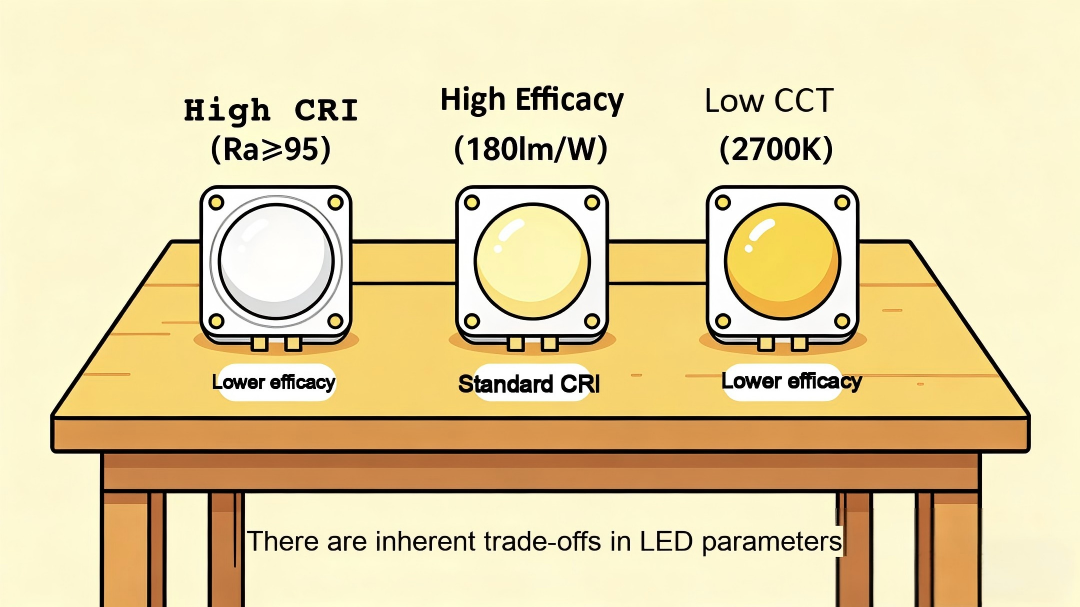
In the world of LED specifications, there are two "seesaws" you need to know about:
-
Increase the CRI (Color Rendering Index), and the efficacy drops.
-
Warm up the Color Temperature (CCT), and the efficacy drops again.
This isn't because manufacturers are cutting corners—it’s simply the laws of physics. Let’s break down why these trade-offs exist so you can make the best choice for your next project.
1. Higher CRI = Lower Efficacy
The most common way to make a white LED is by using a blue chip coated with yellow phosphor. The blue light hits the phosphor, and the mix creates white light. However, this spectrum lacks red, resulting in poor color rendering (usually around Ra 70-80).
To improve the CRI, we have to "fill in" the red part of the spectrum. The standard way to do this is by adding red phosphor.
The catch? Red phosphor has a much lower conversion efficiency than yellow phosphor. If a blue chip produces 100 lumens with yellow phosphor, switching to a high-CRI red phosphor mix might drop that output to 70-80 lumens.
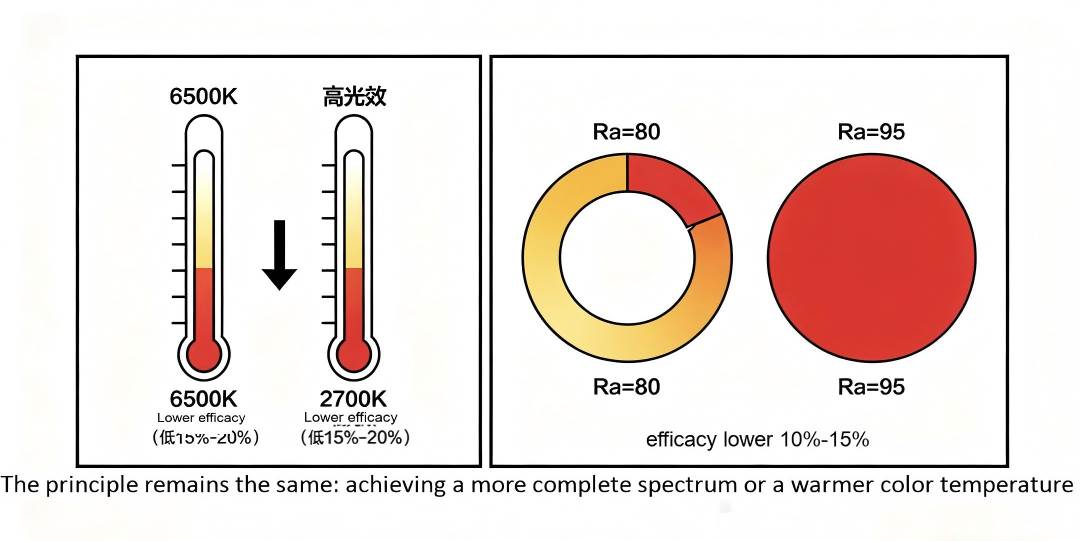
The Physics Check: For the same chip size and color temperature, jumping from Ra 80 to Ra 90 typically results in a 10-15% drop in efficacy. The closer an LED gets to mimicking natural sunlight, the more red light it needs—and red phosphor is inherently less efficient.
Simple Conclusion: If you want colors to look real (High CRI), you have to accept a hit in brightness.
2. Lower Color Temperature = Lower Efficacy
Color temperature also plays a major role. To get a "warm" LED (lower CCT), you need a higher proportion of yellow and red phosphors. As we’ve established, these longer-wavelength phosphors are less efficient at converting energy.
Furthermore, there is the human eye factor. Our eyes are most sensitive to wavelengths around 555nm (yellow-green) and much less sensitive to deep reds and blues. Warm light spectrums contain more red and less yellow-green. Even if the total radiant power is the same, our eyes perceive the warm light as "dimmer."
The Comparison: At the same chip size and CRI, a 2700K (Warm White) light is usually 15-20% less efficient than a 6500K (Cool White) light. It’s not a "bad" bulb; it’s just that humans aren't evolved to see warm light as "bright."
Simple Conclusion: If you want a cozy atmosphere (Low CCT), you have to sacrifice some raw lumen output.
3. How to Choose? It’s All About the Application
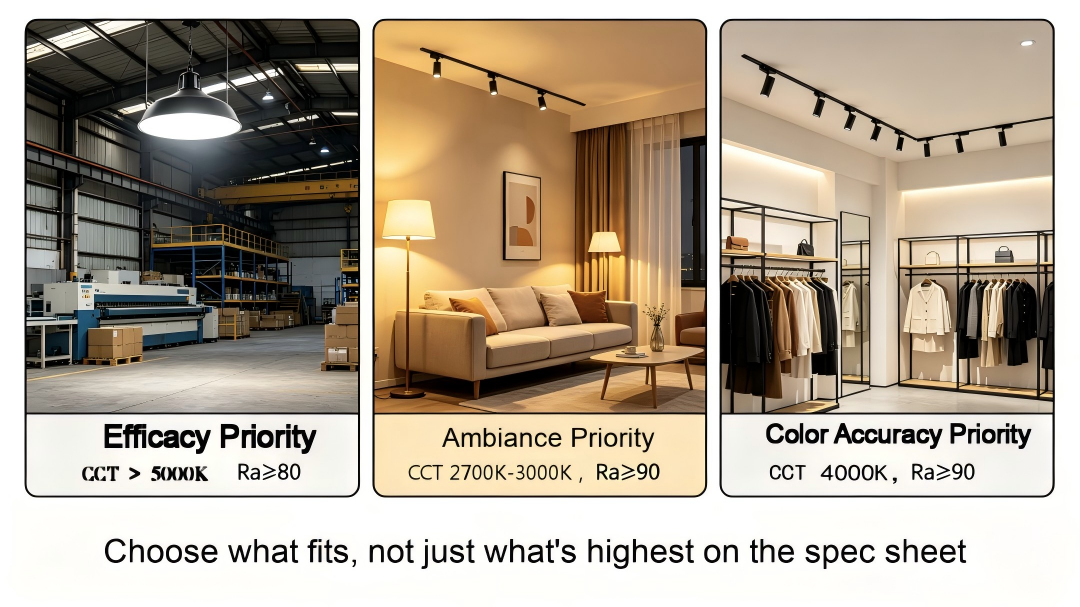
There is no "perfect" LED—only the right LED for the job. Here is how to navigate the trade-offs:
-
Warehouses, Roads, & Parking Lots: Choose high-efficacy products (5000K+, Ra ≥ 80). Brightness and energy savings are the priorities; color accuracy is secondary.
-
Homes, Restaurants, & Hotels: Choose low CCT, high CRI (2700K-3000K, Ra ≥ 90). Atmosphere and comfort come first; a slight loss in brightness is a fair trade.
-
Offices & Classrooms: Go for a balanced approach (4000K-5000K, Ra ≥ 90). You need visual clarity and comfort without wasting too much energy.
-
Museums & High-End Retail: Choose ultimate color rendering (3000K-4000K, Ra ≥ 95). Color reproduction is the core mission; efficacy and cost are secondary concerns.
|
English (Technical) |
English (Marketing/Blog) |
|
High CRI / High Ra |
Vivid colors / True-to-life color |
|
High luminous efficacy |
Maximum brightness / Energy saving |
|
Low Color Temperature (CCT) |
Warm, cozy glow |
|
Lower efficacy |
A hit in brightness / Less efficient |
|
Performance trade-offs |
Finding the right balance |
The Bottom Line
Under the same chip size, remember these two physical realities:
-
Higher Ra = Lower Efficacy (Adding red light sacrifices efficiency).
-
Lower CCT = Lower Efficacy (Human eyes are less sensitive to warm light).
Don’t look for an all-rounder. Ask yourself: Does this space need Maximum Brightness, Cozy Vibe, or Accurate Color?
What about you? Would you sacrifice brightness for better color or a warmer vibe?
-
A: Yes, atmosphere and color are everything.
-
B: No, I need maximum brightness.
-
C: It depends on the project.
Let’s chat in the comments!


