In lighting design or engineering projects, you will frequently encounter a specific unit: Lux (lx).
For example:
-
Office Lighting Requirement: 500 Lux
-
Mall Aisle Lighting: 300 Lux
-
Warehouse Lighting: 150 Lux
Many people new to the industry often ask: "The luminaires already have a Lumen (lm) rating. Why do we still need to look at Lux?"
The truth is, these two units focus on completely different things.
1. What is Illuminance (Lux)?
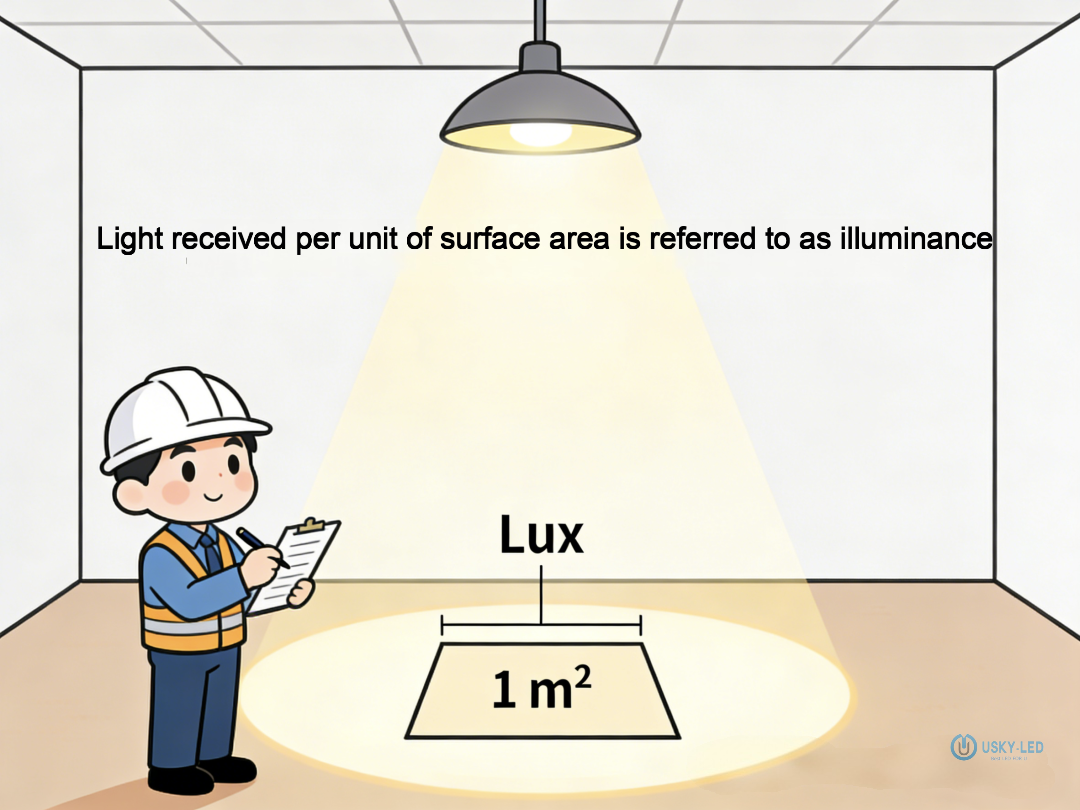
Illuminance is measured in Lux (lx). It represents how much light is actually received on a specific surface.
To put it simply:
The formula is straightforward:
$$1\text{ Lux} = \frac{1\text{ Lumen}}{1\text{ Square Meter}}$$
This means if a lamp emits 1,000 lm and it is spread evenly over a 10 $m^2$ area, the illuminance is 100 Lux.
2. Why Lighting Design Must Calculate Lux
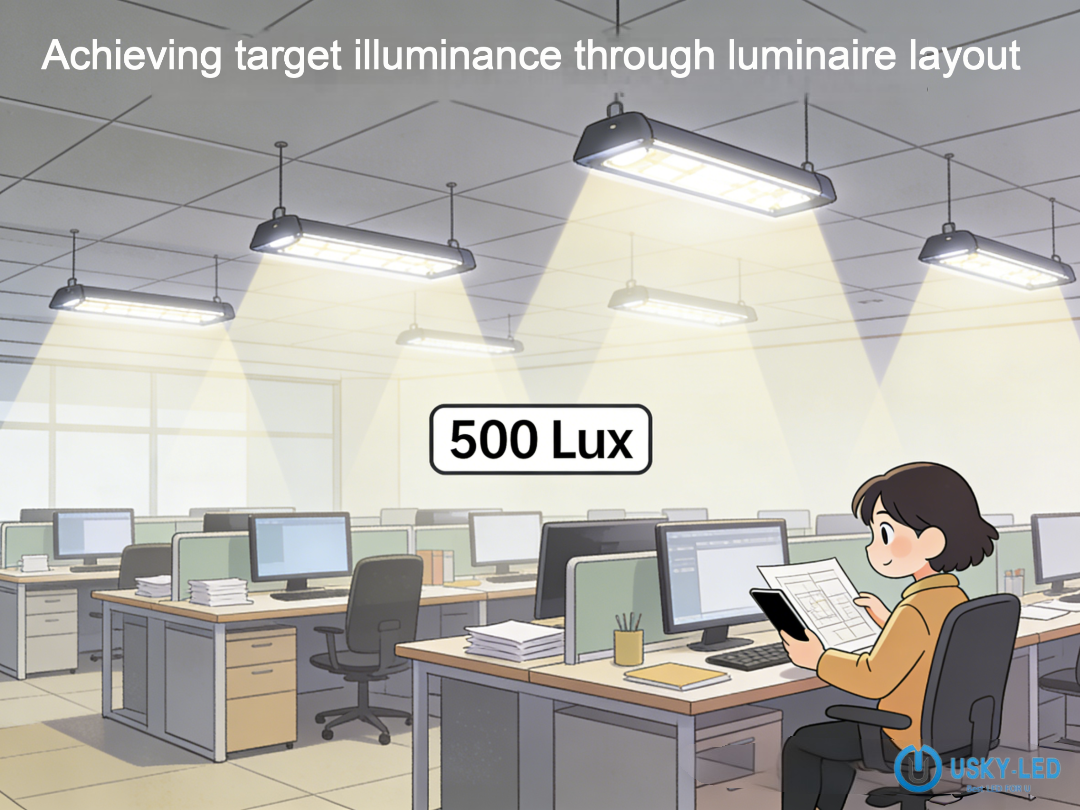
In real-world lighting engineering, the luminaire parameters (Lumens) are only the first step. What really matters is meeting the Spatial Illuminance requirements.
Different scenarios require different light levels:
-
Office Reading/Writing: Generally needs 500 Lux.
-
Mall Corridors: Usually 200–300 Lux.
-
Warehouses: Typically 100–200 Lux.
If you only look at the Lumens of a fixture without considering the installation height, number of fixtures, room area, or beam angle, the final brightness of the space will likely fail to meet industry standards.
This is why designers use calculations or software simulations to ensure the Target Lux is achieved.
3. Why the Same Lamp Produces Different Lux Levels
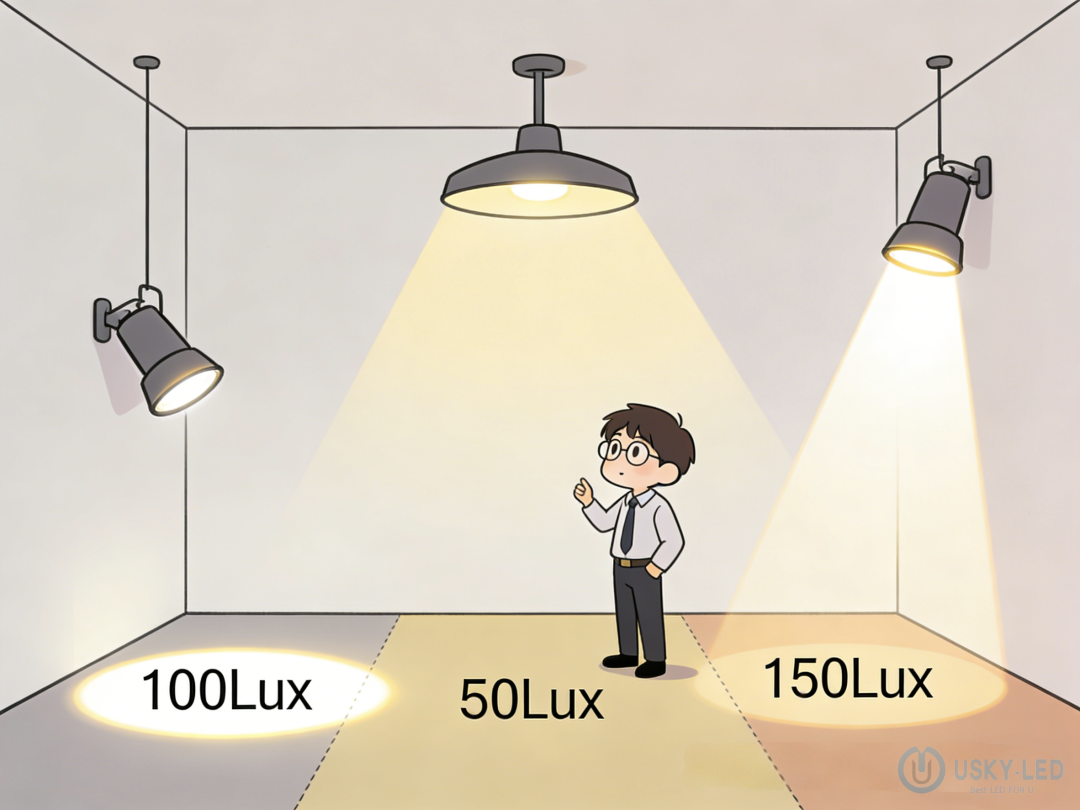
In lighting design, Lux depends on more than just the Lumens of the bulb; it is influenced by several factors:
-
Installation Height: The higher the light, the more it scatters, causing the Lux on the ground to drop.
-
Beam Angle: Narrow-angle fixtures concentrate light more, resulting in higher Lux in a specific area.
-
Quantity and Layout: A logical distribution of fixtures ensures the Lux is uniform across the space.
In many projects, engineers first determine the Target Lux, then "reverse-engineer" the plan to decide how many fixtures are needed and where they should be placed. This is a core logic of lighting design.
Summary
In lighting design, Lumens determine the output power, while Lux determines how bright the space actually feels. This is why project specifications always clearly state the Illuminance Requirement (Lux).
Follow me to learn one new piece of lighting industry knowledge every day.
Feel free to share your thoughts on Lux in the comments!


