Many professionals in outdoor engineering have faced this dilemma: a supplier's quote specifies IP65, but less than six months after installation, the lights fail due to water ingress during a rainstorm. On the flip side, some projects only require basic rain protection, but are quoted with an IP68 budget—driving costs up by 30% and killing any chance of winning the bid.
What do these numbers actually mean? Which one do you truly need? Let’s break it down once and for all.
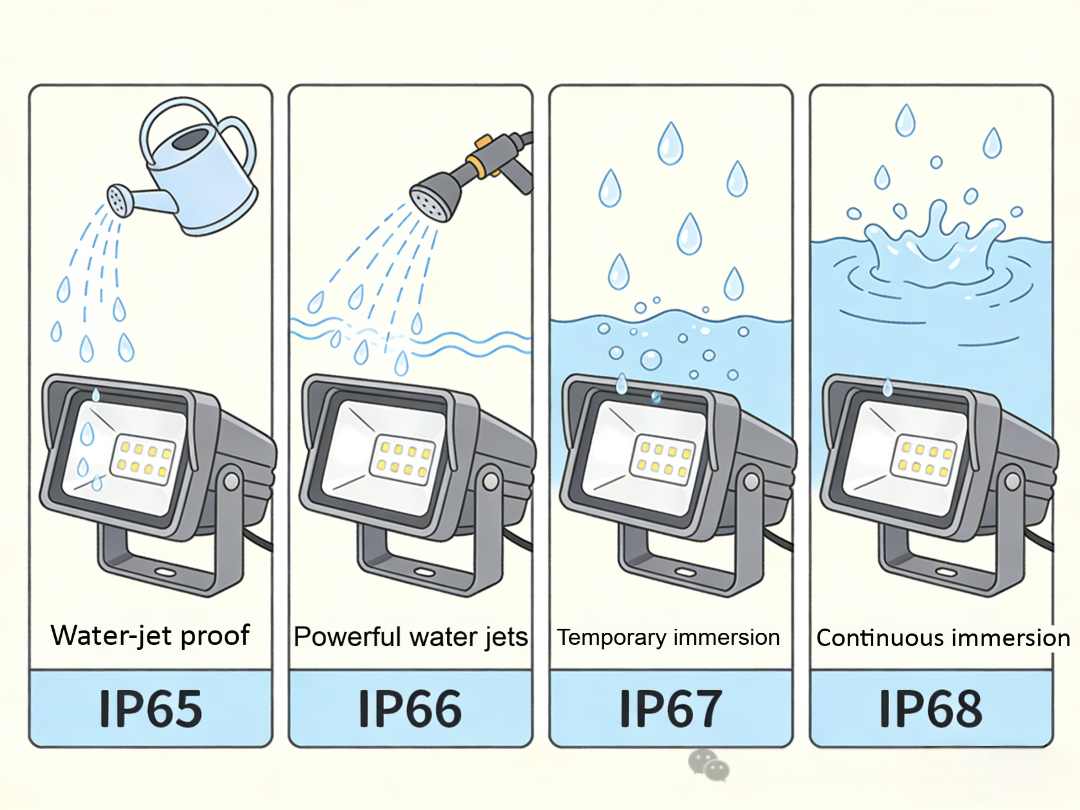
1. Understanding the IP Rating System
The IP (Ingress Protection) rating is an international standard defined by the IEC. It consists of two digits:
-
First Digit (0–6): Dust Protection. "6" represents a total vacuum seal against dust—the baseline requirement for outdoor lighting.
-
Second Digit (0–8): Water Protection. Digits 5 through 8 correspond to different intensities of water resistance:
-
IP65: Protected against water jets (water sprayed from any angle).
-
IP66: Protected against powerful water jets (e.g., heavy seas or high-pressure spray).
-
IP67: Protected against temporary immersion (30 minutes at a depth of 1 meter).
-
IP68: Protected against continuous submersion (depth and duration specified by the manufacturer).
2. Why is there such a huge price gap?
The difference in ratings is reflected directly in structural design and material costs:
| Rating |
Structural Features |
Best Use Case |
Cost Baseline |
| IP65 |
Basic seals + waterproof connectors |
General outdoor areas (rain, no puddles) |
Lowest |
| IP66 |
Thickened seals + double-layer structure |
Coastal areas, typhoon zones, high-pressure washdowns |
+15-20% |
| IP67 |
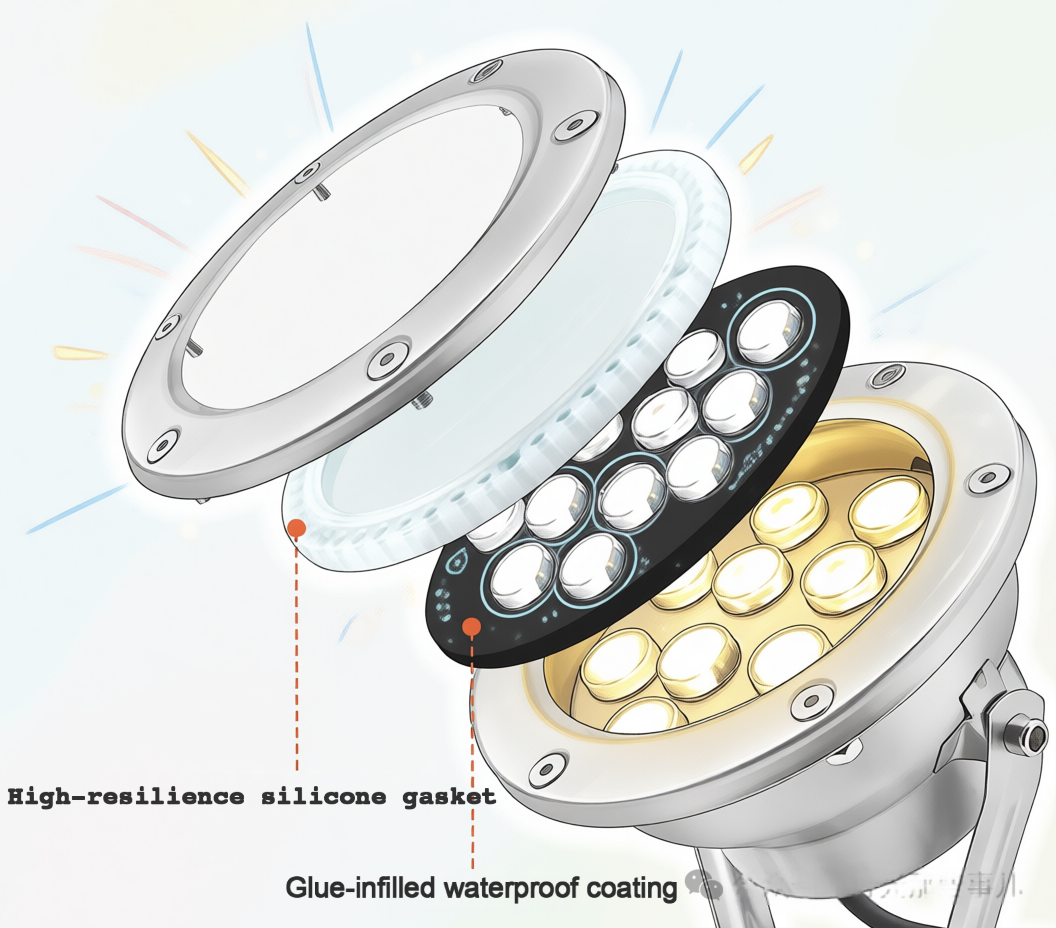
Fully sealed + resin potting or secondary encapsulation |
Areas prone to puddling or flash flooding |
+30-40% |
| IP68 |
Fully sealed + potting + reinforced housing + underwater cables |
Underwater landscapes, fountains, pools |
+100% or more |
Crucial Misconception: IP67 is not necessarily "better" than IP66. IP67 tests for static immersion, while IP66 tests for high-pressure kinetic force. A fixture in a typhoon-prone coastal area needs the force resistance of IP66, not just the immersion resistance of IP67.
3. Choosing the Right Grade for Your Project
Selecting the correct rating determines both cost-efficiency and product lifespan:
-
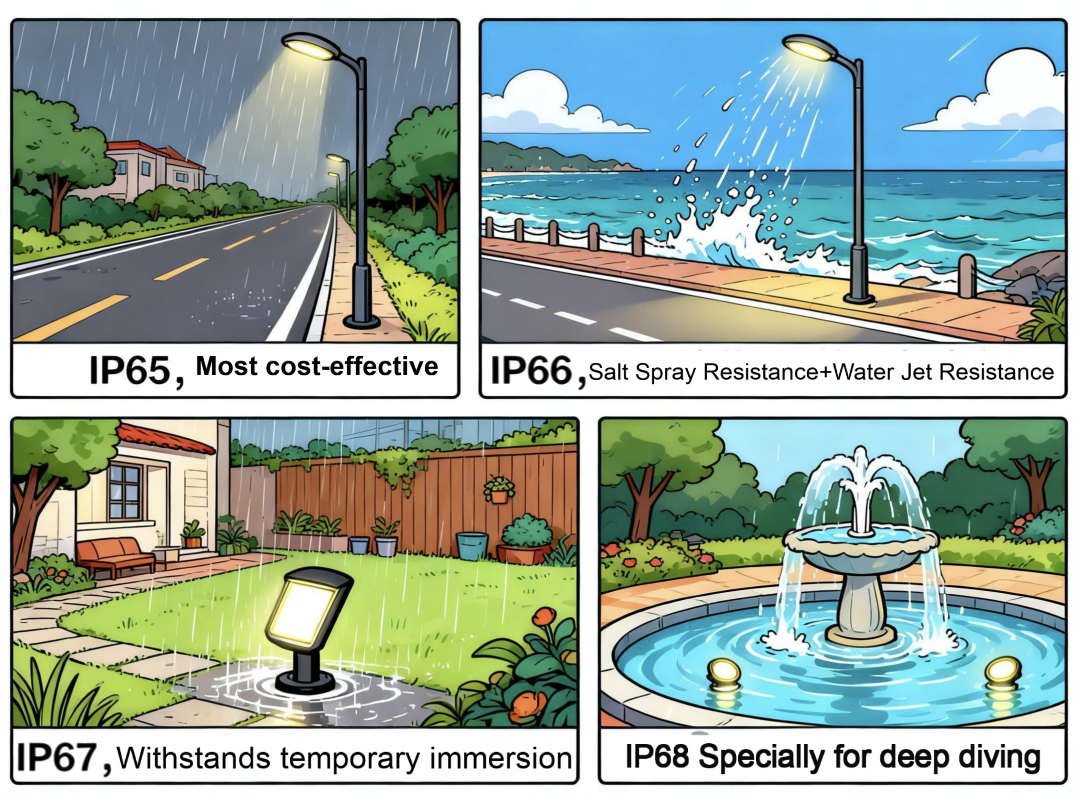
Road Lighting, Garden Lights, Wall Lamps: IP65 is enough. These are installed high up; they face rain but never standing water. Don't overspend here.
-
Coastal Areas & Bridges: IP66 recommended. You need to account for salt spray and the physical force of wind-driven rain.
-
Flood-Prone Areas & Underground Entrances: IP67 is a must. Heavy storms can cause temporary flooding; IP65 will fail under pressure.
-
Underwater Landscapes & Pools: IP68 is mandatory. Ensure the manufacturer specifies the exact depth (e.g., 1m or 3m) and continuous working time.
-
Ground-Mounted Linear Lights: IP67 recommended. Even if the environment seems dry, ground-level lights often sit in
puddles after rain.
🛡️ Pro-Tips to Avoid Common Pitfalls
-
Request Test Reports: Ensure the report comes from a legitimate, third-party testing institution.
-
Clarify IP68 Conditions: "IP68" is a flexible standard; always ask: How deep? For how long?
-
Think Beyond the Number: IP66 and IP67 serve different purposes; don't assume a higher number covers all scenarios.
-
Consider Heat Dissipation: Higher waterproof ratings often mean tighter seals, which can trap heat. Confirm if the power needs to be derated to prevent overheating.
The bottom line: There is no "best" rating—only the "right" rating. Choose correctly to control costs and ensure longevity; choose poorly and prepare for expensive maintenance and replacements.
Let’s Discuss:
In your past projects, have you ever missed the mark on waterproof ratings?
-
A: Under-specced (Water ingress and rework)
-
B: Over-specced (Wasted budget/Lost bid)
-
C: Always stayed with IP67 (Standardized and safe)
Share your experiences in the comments below!


